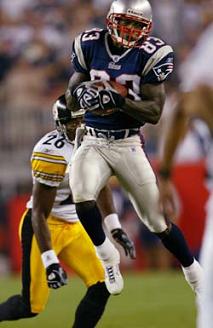
In what seems like an unprecedented move, New England Patriots holdout wide receiver Deion Branch has, through the NFLPA,
filed a grievance against the team because it won't trade him. Branch, who was the MVP of Super Bowl XXXIX, is entering the last year of his five-year rookie contract
And in the last 24 hours--and perhaps to the surprise of the Patriots--Branch has received two lucrative six-year contract offers, from the New York Jets and Seattle Seahawks, in the $36 million to $39 million range, with $13 million worth of guaranteed money. So he got what he thought he was worth. But here's the problem: both teams have apparently offered one second round pick and an established wide receiver (Laveranues Coles is said to be the Jets' offered player), whereas the Patriots are demanding two first round picks. To me at least, that seems like a rather pricy extraction for a 26-year-old player
who has never had 1,000 yards receiving or caught more than 78 passes in a season.
And therein lies the essence of Branch's grievance: he contends that the Patriots are undervaluing his financial worth, but overvaluing his trade value, and they shouldn't be able to have it both ways, especially since they agreed to deal him for a "fair and reasonable" return. The NFLPA, led by attorney Richard Berthelsen, agrees that the Patriots have
"reneged" on their deal, and that the team should be required to trade Branch.
On the other hand, what the heck does "fair and reasonable" mean, and who should get to decide that? Moreover, should players be able to "force" teams to trade them? A special master--who works for both the NFL and NFLPA--will decide all of that in the coming days in an emergency hearing.
My prediction: if the Patriots don't trade him over the weekend, Branch will lose his grievance, because for a special master to command the Patriots to trade him could set a curious and likely undesirable precedent whereby players could use the greivance process to compel not only trades, but the return teams obtain in those trades.
Update (9/2/2006): Through the NFLPA, Branch has filed
two grievances against the Patriots. The first alleges that the Patriots broke their pledge to trade him for a "fair and reasonable" return. That claim is addressed above, and will be heard in the next seven days by one of two special masters,
Professor John Feerick of Fordham University School of Law or
arbitrator Shyam Das. Branch will be represented by NFLPA general counsel
Richard Berthelsen, outside counsel
Jeffrey Kessler, and his personal attorney,
Peter Ginsberg. The second grievance alleges that the Patriots failed to negotiate in good faith over Branch's contract extension. It will be heard by special master
Professor Stephen Burbank of the University of Pennsylvania Law School, although no date has been scheduled.
 unintentionally struck her in the head with a golf club during a driving-range practice (leading to blindness). In a footnote, the court notes “an increase in golf-related head injuries in recent years, particularly in children under age nineteen, as participation in the sport has increased, with those injuries being caused by mis-swung clubs, errant balls, and golf cart accidents.”